Words to know: dynamics, piano, forte, mezzo-, -issimo, crescendo, decrescendo
If this is your first time learning about music theory, you are in the right place! This post will show you everything you need to know to get started writing or understanding dynamics. If you already have a basic understanding of music, feel free to skip ahead to one of my other lessons.
The elements of music are rhythm, dynamics, form, melody, harmony, tempo, timbre, and texture, and are basically the building block of every song. Some of the elements go by different names in different parts of the world, but no matter what they’re called a piece of music can’t exist without them. Understanding how to use the elements together is the first step to being a great musician. Let’s get started!
What are Dynamics?
Dynamics are basically the volume of the music: loud, soft, or in between. In general, a piece of music will change dynamics many times. Changing dynamics adds interest, and is a great technique to really bring out other changes in a piece of music.
Dynamics, like tempos, run more or less on a spectrum. There are a lot of different words that relate to dynamics, depending on the volume the composer wants to use. Also similar to tempos, all of the words are written in Italian. However, there are two main dynamics that all of the other dynamics are based off of. For a beginning composer or music theory student, it may be best to just start experimenting with these two dynamics before exploring the others. These two dynamics are piano and forte.
Piano
Piano in music is the dynamic marking for a “soft” volume. This is not to be confused with the instrument called the piano, although that is where the instrument got its name. When written out, the word piano is in Italics because the word itself is Italian. Most traditional music words are in Italian because when these techniques and words were developed, the center of music was in Italy.
Forte
Forte in music is the dynamic marking for a “loud” volume. Sometimes, especially with younger students, teachers will refer to forte as “full” instead of loud because young musicians don’t always have the kind of control on their instrument to have different versions of “loud.” Forte is generally considered a comfortable playing dynamic, with a little more volume than your average sound.
What if I want something besides just “loud” or “soft?”
There are often times in music when composers want a dynamic that is softer than piano or louder than forte, or maybe something between the two. There are two ways that composers accomplish this. They either use the Italian prefix mezzo– (“medium” in English) or the suffix -issimo (“extremely” in English).
For example, if a composer wants to write a piece of music that is louder than forte, they would keep the forte part and add the suffix -issimo to create the new dynamic fortissimo. In the same way, a composer could use a dynamic softer than piano by adding –issimo and making the dynamic pianissimo.
For the in-between dynamics, composers use the prefix mezzo- instead. So to make a dynamic that is medium-loud, a compose would write mezzo-forte. This would be softer than forte, but louder than piano. The same principal applies to mezzo-piano, which would be a little louder than piano.
One important thing to know about dynamics is that composers almost never write out the whole word. Instead, we use abbreviations to save space. For example, forte would be written as f and piano would be written as p. Below is a chart of the main dynamics that composers use and the abbreviations you’ll see in music, as well as a musical example.
| Dynamic Name | Abbreviation | Meaning |
|---|---|---|
| pianissimo | pp | Very soft |
| piano | p | Soft |
| mezzo-piano | mp | Medium soft |
| mezzo-forte | mf | Medium loud |
| forte | f | Loud |
| fortissimo | ff | Very loud |
Listen to this example and see if you can hear the notes getting louder as it goes from pianissimo to fortissimo.

Other Dynamics
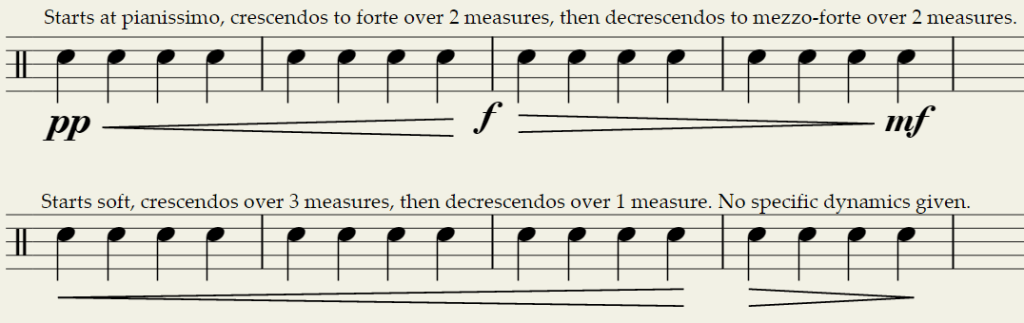
There are a few other music markings that fall under “dynamics” but are not any of the words written above. Two that musicians see very often are “crescendo” and “decrescendo.” These are also a little unique because of being written as words or even as abbreviations, they are most often written as pictures; either a stretched out “greater than” or “less than” sign (see below for pictures).
Crescendo is another Italian word that means to gradually get louder. To perform this, a musician would start at whatever their last dynamic marking is and gradually get louder until the end of the crescendo. They would then stay at that dynamic until it changes again. Often, the end of a crescendo is marked with a specific dynamic (such as a piano that crescendos to forte), but sometimes the one or both ends of the crescendo is not marked with a specific volume level.
A decrescendo works the same way, but in reverse; the musician starts at a louder volume and gets gradually softer until the end of the decrescendo. For either a crescendo or a decrescendo, the musician typically only has the amount of time to change dynamics equal to the length of the actual picture of the music marking. Below is a musical example of crescendos and decrescendos with and without dynamics marked.
The chart in the previous section has most of the dynamics that musicians will see in music. Theoretically, dynamics could go infinitely louder or softer, and occasionally you could see music marked as ffff or ppp. The important thing to realize with dynamics is that all of them are a little subjective. What one person hears as mezzo-piano another may hear as mezzo-forte. A forte on a trumpet will be a different level than a forte on a harp. As long as all of the performers or the composer understand how to use them and keep all of the dynamics relative, the music can still sound beautiful.
Recap
In this lesson we talked about dynamics being the volume of music, and that they can be loud, soft, or anything between and beyond. We talked about piano and forte and how all of the other dynamics are some version of those two primary dynamics. We also talked about some other important dynamic-related things that musicians will see and how they are used in music.
When you feel comfortable with dynamics, go on to my next lesson on tempo! There is a lot more to learn about music and I’m happy to be able to help.
If you got value from this lesson, consider sharing this site with your friends who are interested in music. Also, don’t forget to subscribe to my website so you get notified when new lessons come out!
Thanks for reading, and have fun making music!
 Sam Adams Studio