Words to know: melody, treble clef, bass clef, pitch, note, scale, staff, key signature
If this is your first time learning about music theory, you are in the right place! This post will show you everything you need to know to get started writing or understanding melody. If you already have a basic understanding of music, feel free to skip ahead to one of my other lessons.
The elements of music are rhythm, dynamics, form, melody, harmony, tempo, timbre, and texture, and are basically the building block of every song. Some of the elements go by different names in different parts of the world, but no matter what they’re called a piece of music can’t exist without them. Understanding how to use the elements together is the first step to being a great musician. Let’s get started!
What is Melody?
In simple terms, a melody is the part of a song that you can sing along with. Melodies can be short or long, high or low, and often repeat. In popular music, the melody is usually the most memorable part of the song. In classical music, such as the “Nutcracker” ballet, melodies are often used to represent specific characters. Even in modern movies and television composers use melodies to denote characters. Think about the “Star Wars” movies. Almost every time we see Darth Vader on screen we hear the iconic “Imperial March.” Melodies consist of notes and rests, as well as additional information called “pitch.”
Pitch
Pitch is a letter name that we give each note based on the frequency of that note. All sounds are created by vibrations, and frequency is just how fast a particular sound vibrates. It is not important to know what those frequencies are right now, just that the faster the frequency is, the higher the note.
In the musical alphabet, there are eight “natural” notes and they are arranged just like the regular alphabet. Think of these notes as the white keys on a piano keyboard.

Because of the way we hear scales in Western music (more on scales in a different lesson), we only have these eight pitches before we start our musical alphabet over again. Each new pitch gets a little higher than the last when we move through the alphabet normally. If we go backwards through the letters, each note would get lower.
*Note: on a piano keyboard, moving to the right makes notes go higher and moving to the left makes notes go lower.
So we start on A, then go B, C, D, E, F, and G, before starting over again at A. This new A is higher than the previous one, and all of the notes after it continue getting higher. Technically, this new A is twice the frequency of the original A, so it is higher by what musicians call an “octave.” For more information about octaves and frequencies, check out the intervals lesson.
Staff and Clef
Before we look at an example of these pitches, we need to talk a little bit about how we see them written. In music, we always have a set layout of five parallel, horizontal lines where we place all of our notes and rests. These five lines together is called a “Music Staff.” Each line and even the spaces between the lines represent a different pitch in our musical alphabet.

One thing that can be a little tricky for new musicians is that for some instruments, the pitches are in different places on the staff. This is because of the playing range of different instruments. Some instruments are very high, like a flute or violin, and some are very low like a bass or tuba. It wouldn’t make sense to try to write all of these high and low notes on the same five lines. So to fix this problem, musicians developed “clefs.” A clef is a symbol at the beginning of a piece of music that tells you if you’re going to use high notes, low notes, or in between. There are a lot of different clefs, but for this lesson we will talk about two: treble clef and bass clef.
Treble Clef
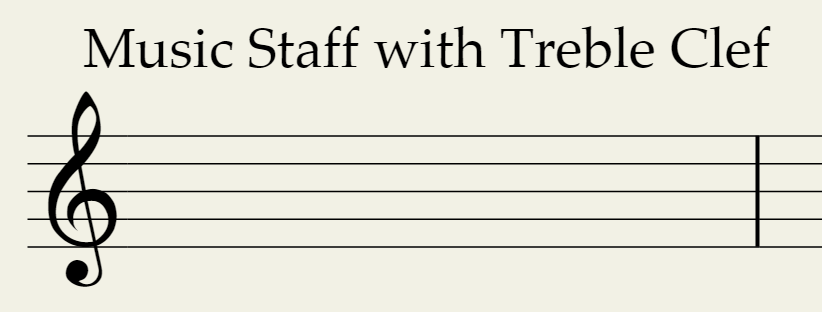
This is a treble clef. When we see a treble clef it means that we are going to be using a higher set of notes. High-pitched instruments such as flute, violin, clarinet, trumpet, and the right hand of piano parts are written in treble clef. Women also generally sing treble clef notes because their voices are usually higher.
Now let’s add the pitches:
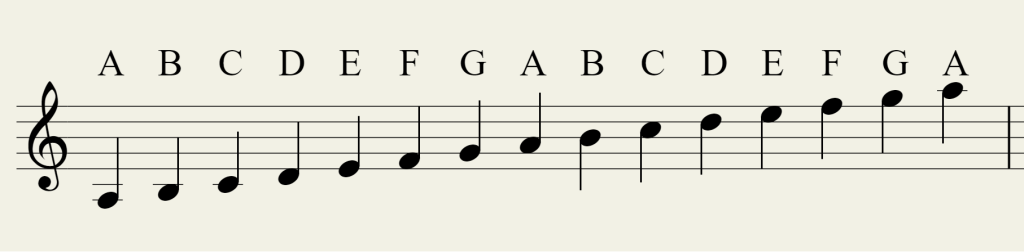
Here you can see the letter names of the notes written out above the pitches. You may have noticed that some of the notes are above or below the music staff. We’ll talk more about that in another lesson, but it is because pitches can theoretically go on forever in either direction. You may also notice that some of the notes on the staff look upside-down. That’s just to make it a little easier to read higher notes, it doesn’t change anything so don’t let it confuse you. For now, the important thing to know is that the musical alphabet repeats and that as the pitches get higher, they also physically get higher on the music staff. So the A all the way on the right is much higher than the A all the way on the left.
One important thing to know about the musical alphabet, no matter which clef you look at, is that the pitches alternate on the lines and spaces, and that they move alphabetically. This means that if you know one particular pitch, you can always count up or down on the staff to figure out the others. Luckily, musicians have also come up with a way to easily remember the most-used pitches. We use an acrostic, or a sentence where the first letter of each word represents one part of an idea. This is like in math class when they use “Please Excuse My Dear Aunt Sally” to remember the order of operations (Parentheses, Exponents, Multiplication, Division, Addition, Subtraction).
We have one acrostic for the line notes and another for the space notes. For the treble clef notes, the spaces actually spell the word “face” from low to high, and the sentence I learned for the line notes is “Every Good Boy Does Fine,” also from low to high. The first letter of each word tells you the pitch name of that line. Look at the line and space notes on the staff below.
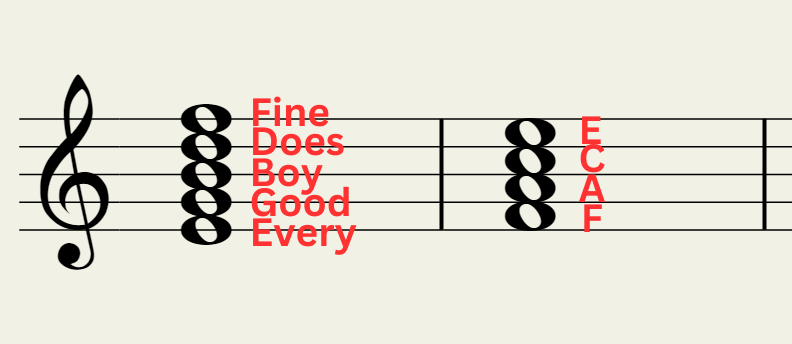
Of course, these are not the only acrostics that can be used for this. I’ve also heard “Every Good Boy Deserves Fudge” and “Even Granny Betty Drives Fast.” It doesn’t really matter as long as it’s something that you can remember. Try to come up with your own!
Bass Clef
Bass clef notes work the same way, except they are in a slightly different place on the staff. Bass clef notes are for low voices, like basses, tubas, trombones, cellos, bassoons, or the left hand of the piano part. Men with lower voices often sing in bass clef. Here are some examples of bass clef notes:
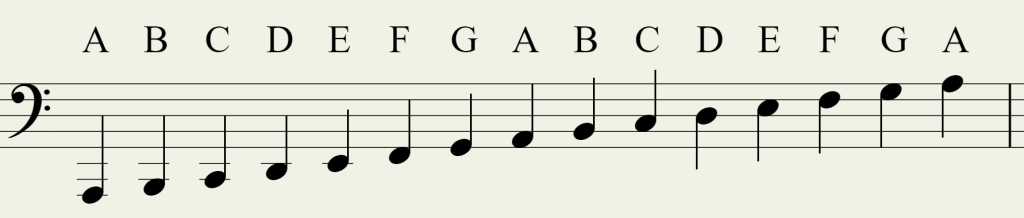
Notice that the clef picture is different now, and there is a bass clef instead of a treble clef at the beginning of the music. Also notice that the pitches still alternate lines and spaces, and they still follow the repeating musical alphabet.
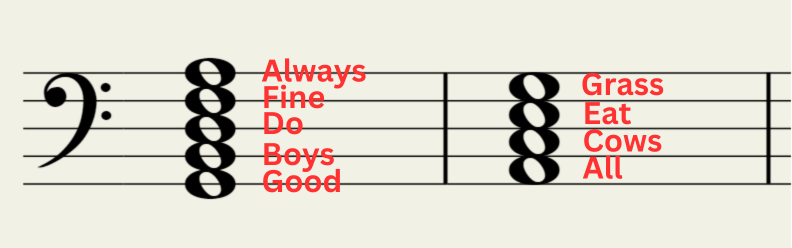
There are two acrostics that we use to help remember the bass clef notes. For lines, the one I learned is “Good Boys Do Fine Always” and for spaces I learned “All Cows Eat Grass.” Both of these are from low to high-pitched, just like with the treble clef. You are always welcome to come up with your own, but here are the bass clef notes with the acrostic words added:
Now that we’ve talked about what the pitches are and how they are written, let’s look at how composers use them to create a melody.
Putting it All Together
Let’s take a look at an example. On the staff below, there is a song with a treble clef part and a bass clef part. The treble clef part (higher notes) in this example is the melody, which means that it is likely the part that you would walk away singing. Listen to the melody as you watch the music.
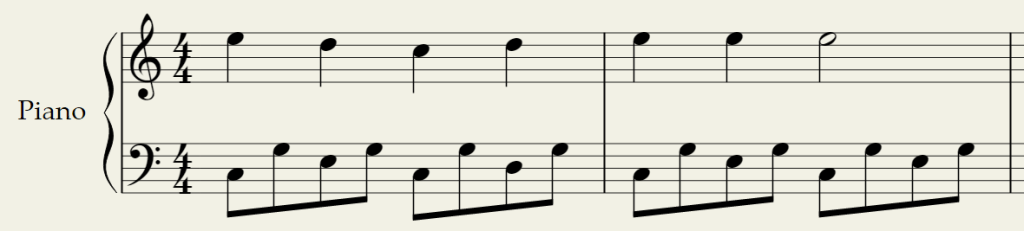
You should have been able to hear that melody and maybe even recognize it pretty easily. Now listen to the example again and try to sing along with the bass clef part (lower notes). Is it harder? It is definitely not as catchy, though it is still important. We call this part “harmony” which we talk about in another lesson.
Now that you know what the pitches are called and how to write them, try writing your own melody!
Recap
In this lesson, we talked about melody. We talked about how melodies are made up of pitches, and that those pitches have letter names. We looked at clefs, and talked about how different clefs use different pitches, plus saw examples that use easy to remember sentences to learn where those pitches go. Lastly, we saw an example of how a composer could use those pitches in a certain order to create a melody.
When you feel comfortable with melody, go on to my next lesson on harmony! There is a lot more to learn about music and I’m happy to be able to help.
If you got value from this lesson, consider sharing it with your friends who are interested in music. Also, don’t forget to subscribe to my website so you get notified when new lessons come out!
Thanks for reading, and have fun making music!
 Sam Adams Studio