Words to know: harmony, pitch, chord, harmonic line
If this is your first time learning about music theory, you are in the right place! This post will show you everything you need to know to get started writing or understanding harmony. If you already have a basic understanding of music, feel free to skip ahead to one of my other lessons.
The elements of music are rhythm, dynamics, form, melody, harmony, tempo, timbre, and texture, and are basically the building block of every song. Some of the elements go by different names in different parts of the world, but no matter what they’re called a piece of music can’t exist without them. Understanding how to use the elements together is the first step to being a great musician. Let’s get started!
What is Harmony?
The simplest definition of harmony is two or more pitches being played at the same time. For the purposes of this lesson, we are not counting unpitched notes, like drums, as harmony. Usually, a harmony part is written to bring out or emphasize a melody (if you haven’t checked out my lesson on melody yet, make sure to do that first!). A pitch is identified by a letter name, and represents a specific frequency. We’ll talk about pitches more when we talk about melody.
Harmonies can be very simple or very complex. We are not going to get into the complex harmonic ideas in this lesson. Instead we will focus on chords and harmonic lines.
Chords
In the truest sense of the word, this can be as simple as two notes played together. In the following example, it is the notes of C and E.

You can see that the two notes line up vertically. This means that they happen at the same time. If one of them lined up to the right of the other, then the note on the left would be played first and the note on the right would be played second.
There are many different kinds of chords that we will talk about in another lesson. It is not important to understand every kind of chord right now, just the basics of how they work. For now, we will call this a C major chord (a chord that starts on C as the bottom note, and has a “bright, happy” sound). Traditionally, a chord often has a third note; in the case of a C chord, that is a G. Let’s add that note.
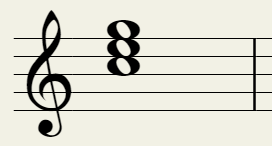
For most compositions, these would be all the notes you would need to have a nice-sounding chord to go along with your melody. Just for fun, let’s add more notes to ours. I’m only going to add C’s, E’s, or G’s, so there will be no new letter names, just different octaves. Let’s see what that looks like.
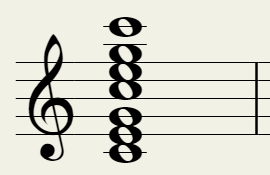
You can see that even with all of these extra notes, they are all still lined up vertically so they all happen at the same time. You can also make a chord between different instruments, as long as all of the notes happen together. For example:

In this example, there is still just one chord being played, even though it is spread out across five instruments, because all of the notes are happening at the same time. Composers use different kinds of chords spread across different instruments to emphasize the melody and create interesting textures.
Harmonic Lines
Harmonic lines are a kind of “moving” harmony that happens while a melody is happening. Let’s look at this next example. In this example, there is a melody in the right hand of the piano part and some moving notes in the left hand of the piano part.
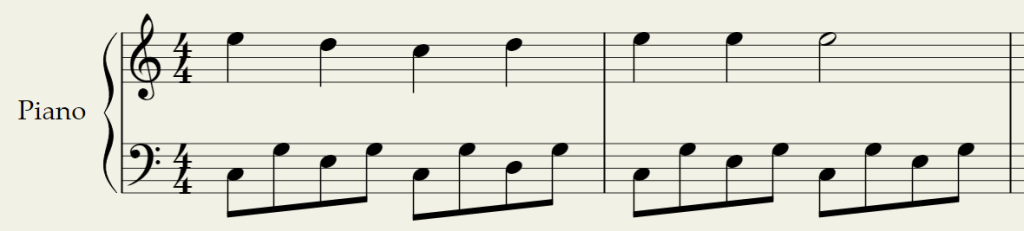
Harmonic lines are great for giving a piece of music a feeling of motion, and can even be combined with chords to create even thicker harmonies. Harmonic lines can have either the same rhythm as the melody or a different rhythm, as in the example above. The important thing is that it happens at the same time as the melody.
Recap
In this lesson we talked about what harmony is, and some basic ways it is used in music. We talked about chords, where two or more notes are played at the same time, and harmonic lines where there is a moving line that brings out the melody. This was just a basic overview and there are many more things to get into when looking at harmony. I hope you’ll start to write your own music and experiment with harmony!
When you feel comfortable with harmony, go on to the next lesson about form! There is a lot more to learn about music and I’m happy to be able to help.
If you got value from this lesson, consider sharing this site with your friends who are interested in music. Also, don’t forget to subscribe to my website so you get notified when new lessons come out.
Thanks for reading and have fun making music!
 Sam Adams Studio