I learned how to play piano at a young age, mainly from hearing songs and figuring out how to play them. It wasn’t until much later that I forced myself to learn to read notes first on piano and then on other instruments. Eventually, I learned what a huge advantage it was as a musician to understand the way a piano works and relates to everything I do.
If you’re not familiar with the layout of a piano, there are basically two kinds of keys you’ll see on one: white keys and black keys. White keys are the “naturals”, meaning there are no sharp or flat names on them, just A, B, C, D, E, F and G. The musical alphabet doesn’t go past G to the rest of the alphabet (although it used to in some parts of the world…that’s another lesson), and instead starts over again at A once the notes goes past G. The black keys are the “accidentals”, which means that they are the sharps and flats. A full-sized piano starts on an A and goes up a little over 7 octaves (or the full musical alphabet seven times) and ends on a C.
As a starting point, we’ll find the note “C.” On the piano keyboard (pictured below) there are black keys in groups of 2 and groups of 3. If you look at one of the groups of 2 black keys and then find the white key directly left of that group, that is C. To find the rest of the white key notes, just follow the musical alphabet in order. Remember to start over again with A once you get to G!
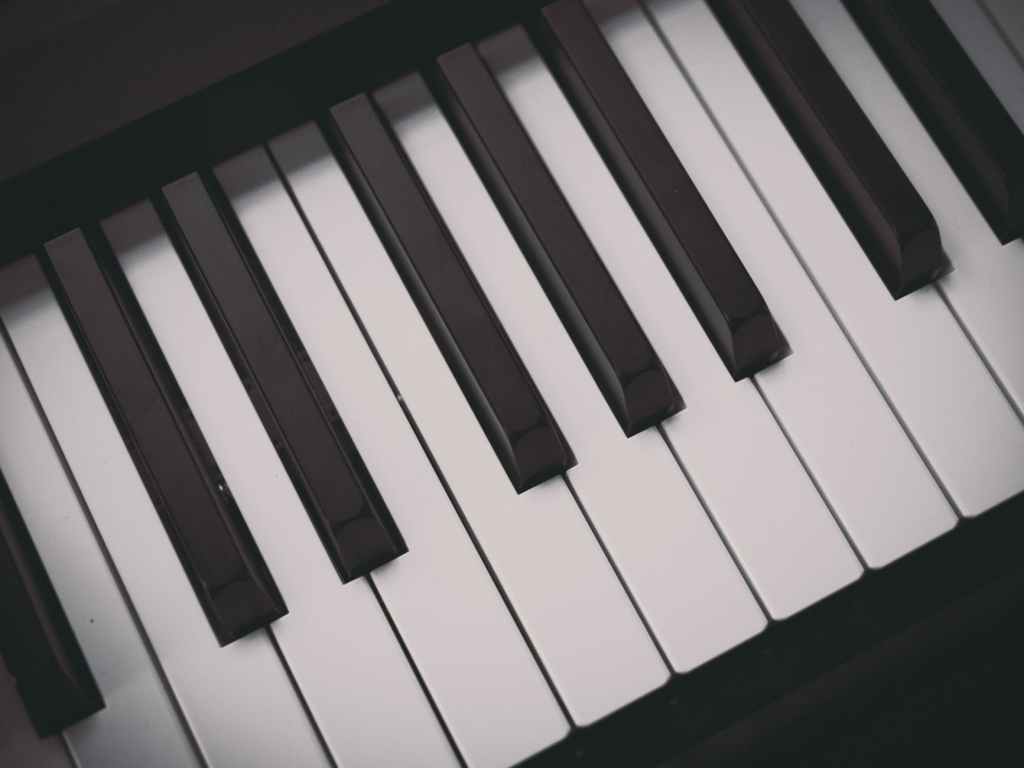
All of the black keys have two names, depending on how you get to them. For example, if you start on the white key “C” and go up to the closest black key, you would call it “C Sharp” (sharps go up one consecutive key from wherever you start). If you instead start on “D” (the next white key after C) and go DOWN to the closest black key, it would be the same key but we would call it “D Flat” instead of “C Sharp”, because you started on D instead of C (flats go down one consecutive key from wherever you start).
There are two places on a keyboard where there is no black key between two white keys. That is between the notes of B and C and between E and F. That layout has everything to do with the way we’re used to hearing music, and I’ll talk about it in more detail in a different lesson. For now just memorizing where the white keys are is all you need to get started.
If you have access to a piano, start learning some songs! I’ll write out the notes for “Mary Had a Little Lamb” below so you can try it out. It uses all white keys, so it’s pretty easy to learn and practice. Watch the video above for some more ideas of what you can do when you get a little more familiar with the piano (this video was originally made for my students so some of it will only make sense if you’re in my class).
Thanks for reading. Let me know what else you’d like to see and subscribe to my website so you can get updated when I send out new lessons!
Mary Had a Little Lamb
E-D-C-D-E-E-E
D-D-D (hold this last one out for a second)
E-G-G (hold this last one out for a second)
E-D-C-D-E-E-E-E
D-D-E-D-C
 Sam Adams Studio
1 thought on “Piano: A Great Tool for All Musicians”